English
 Arabic
 French
 Spanish
 Portuguese
 Deutsch
 Turkish
 Dutch
Dutch
 Italiano
 Russian
 Romaian
 Portuguese (Brazil)
 Greek
Greek

Anti Social Social Club (ASSC) and Its Impact on US Fashion Culture
Shopping |
2026-01-30 12:31:46
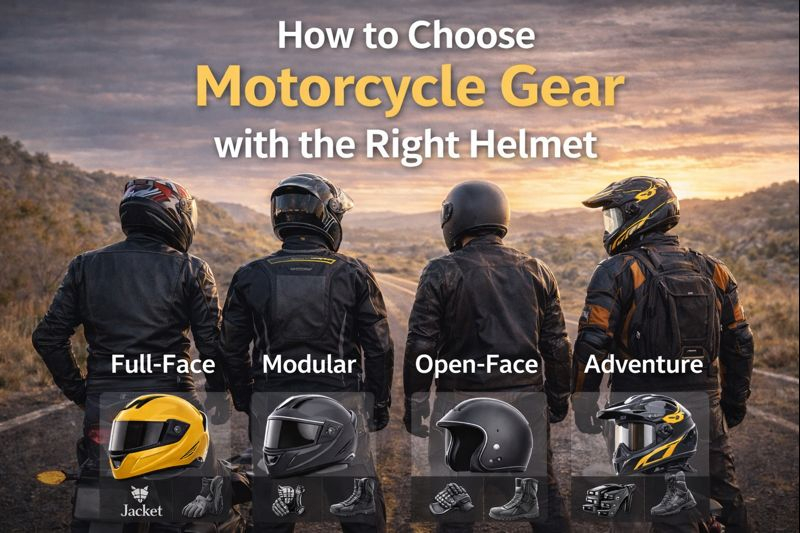
Selecting motorcycle gear begins with choosing the right helmet, as head protection is the most critical element in any rider safety system. Helmets influence not only impact protection but also visibility, comfort, communication compatibility, and how other gear—such as jackets, gloves, and eye protection—integrates during real-world riding. A helmet that aligns with riding style, environment, and gear configuration significantly reduces injury risk and improves riding performance.
This article provides a comprehensive, fact-driven guide to choosing motorcycle gear by first selecting the appropriate helmet, with a focused examination of Full Face Helmets and Modular Helmets. It explains helmet technologies, industry standards, practical use cases, and expert-recommended practices to support informed, long-term gear decisions.
Motorcycle gear functions as a coordinated protection system. The helmet dictates airflow patterns, collar compatibility, eyewear integration, and communication device placement. Poor helmet selection can compromise jacket neck seals, increase wind noise, and create pressure points that lead to fatigue.
Safety research summarized in educational resources such as Wikipedia’s overview of the motorcycle helmet emphasizes that helmets are engineered to manage impact energy, resist penetration, and remain securely positioned during crashes. These functions directly affect how the rest of the gear performs during normal riding and in accident scenarios.
Modern helmets use an EPS (expanded polystyrene) liner that compresses on impact to absorb kinetic energy. Advanced designs incorporate multi-density EPS to manage both low- and high-speed impacts.
Helmet shells are manufactured using:
Thermoplastics for durability and cost efficiency
Fiberglass composites for improved energy dispersion
Carbon fiber for high strength-to-weight performance
Material choice affects weight, fatigue resistance, and long-distance comfort.
Reliable helmets meet recognized safety standards, including:
DOT (United States minimum safety requirement)
ECE (international testing for impact and retention)
SNELL (independent, high-performance testing)
Compliance ensures consistent protective performance under standardized test conditions.
Full Face Helmets provide complete coverage of the head and face, including a reinforced chin bar. They are widely regarded as the most protective helmet type available for street riding.
Full cranial and facial coverage
Reduced wind noise and aerodynamic drag
Integrated visors with anti-fog and UV protection
These features make full face helmets standard in professional racing, high-speed touring, and long-distance riding.
Full face helmets integrate effectively with:
High-collar motorcycle jackets for wind sealing
Neck gaiters and balaclavas
Bluetooth communication systems
Their enclosed design supports stable airflow and consistent helmet positioning, which enhances the effectiveness of surrounding gear.
Highway and interstate travel
Sport and performance riding
Cold or variable weather conditions
Modular Helmets combine elements of full face and open-face helmets through a hinged chin bar mechanism. This design allows the front section to lift, offering convenience during stops without fully removing the helmet.
Easier communication at stops
Convenient for riders wearing glasses
Adaptable for commuting and touring
When closed, modular helmets provide protection levels similar to full face designs, provided the locking mechanism meets safety standards.
Modular helmets work well with:
Touring jackets featuring adjustable collars
Integrated communication and navigation devices
Layered riding gear for frequent on/off transitions
Professional guidance emphasizes ensuring the chin bar is fully locked before riding at speed.
Urban commuting with frequent stops
Long-distance touring
Riders requiring flexibility without sacrificing coverage
Modular helmets offer convenience and adaptability in stop-and-go traffic.
Full face helmets provide superior wind management and reduced fatigue over extended distances.
Full face helmets are preferred due to aerodynamic stability and full impact coverage.
Matching helmet type to riding style ensures both safety and gear compatibility.
Safety professionals and gear specialists recommend the following practices:
Fit Precision: Helmets should fit snugly without pressure points to prevent movement during impact.
Gear Alignment: Helmet shape and size should complement jacket collars and neck protection.
Routine Inspection: Shells, liners, and retention systems should be checked regularly.
Lifecycle Management: Helmets should be replaced every 5–7 years or after any significant impact.
These practices are derived from accident analysis and rider safety training programs.
Different environments require different helmet features and protection levels.
Certified modular helmets provide reliable protection when properly locked.
Comfort is important, but safety certifications and fit are non-negotiable.
Helmets also reduce fatigue, wind exposure, and distraction during normal riding.
Helmet design influences airflow, jacket collar fit, and communication device integration.
Full face helmets offer maximum coverage, while modular helmets provide comparable protection when locked and certified.
Yes, provided they meet safety standards and the chin bar is securely closed.
It should fit snugly with no excessive movement and even pressure distribution.
Yes. Lighter materials reduce neck strain during extended rides.
Helmet laws vary by region, but certified helmets are strongly recommended universally.
Every 5–7 years or immediately after an impact.
No. Structural integrity cannot be restored after impact.
They generally offer better noise reduction due to enclosed design and aerodynamics.
Ventilation and liner systems should align with climate conditions for comfort and safety.
Choosing motorcycle gear begins with selecting the right helmet, as it defines the effectiveness of the entire safety system. Full Face Helmets deliver maximum protection, aerodynamic efficiency, and seamless gear integration for high-speed and long-distance riding. Modular Helmets provide versatility and convenience for mixed riding environments while maintaining certified safety performance. When helmet selection is aligned with riding style, safety standards, and gear compatibility, riders achieve improved protection, comfort, and long-term riding confidence across every journey.